
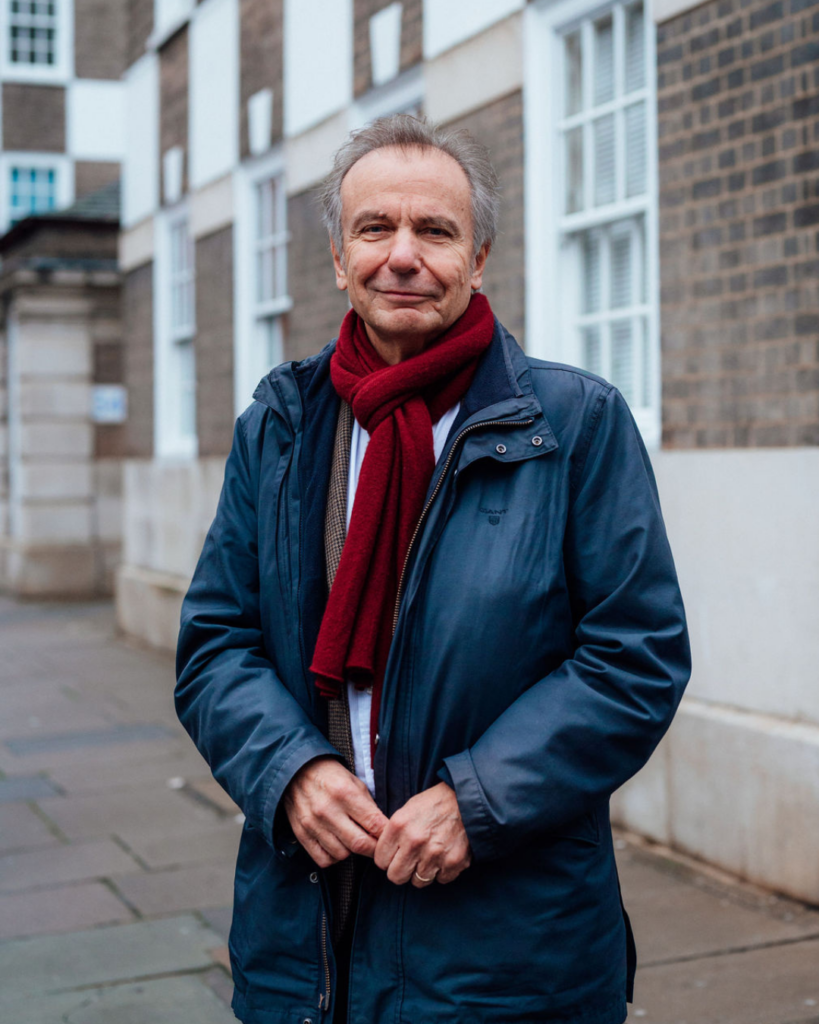
Walking through Page Street on a grey December morning, Nigel sees more than buildings, he sees the history, struggle and care that shape a place. A historical walking tour from a near-forgotten flood to boarded-up flats, contested ideas of “working class,” and neglected gardens awaiting restoration, his story traces the many projects he’s been part of over his career. Nigel’s journey reflects how the places we shape are inseparable from the people who live in them, and the responsibility we carry to both.
For more stories about place, heritage and care for the public realm, read Kate’s reflections on softening the city, or explore how Bridget and Sarah reclaimed King’s Scholars’ Passage through shared purpose.
On a grey December morning, I leave the busy Regency Café, full of locals enjoying steaming cups of tea, bacon butties and full English breakfasts, and step into the drizzle. I am in Page Street and standing like soldiers on either side of me, are rows of chequerboard fronted flats – alternating panels of white stucco and grey bricks, interspersed with white sash windows. On one of the walls, at 3rd floor level, is the Grosvenor family crest topped by the Talbot, a long extinct, powerfully built, hunting dog. And between the buildings are courtyards, some with children’s swings and slides but all full of greenery, from small shrubs to towering eucalyptus trees.
It hasn’t always been like this. Nearly 100 years ago, on the night of 7th January 1928,10 people died and thousands of the poorest people in the city were made homeless in this area of Westminster, in some of the worst flooding ever seen in the City. Living in squalid back-to-back housing, the residents stood no chance as the filthy water from the River Thames poured over the embankment, inundating the area from the Tate Gallery to the Houses of Parliament.
Appalled by this tragedy, Hugh Grosvenor, 2nd Duke of Westminster and the richest man in the country, granted a 999-year lease, on a peppercorn rent, of part of his Pimlico estate to Westminster City Council. He also paid for the construction of some 600 flats, designed by the renowned country house architect Edward Lutyens, on the condition that the flats be rented to ‘working class people.’ Numerous signs proclaim that the buildings are still known as The Grosvenor Estate.
I was used to working with the cream stucco mansions of Belgravia and well remember the contrast when visiting residents in Page Street. Some of the flats still had the bath in the kitchen and others were so over-crowded that people slept in the beds in shifts. Nearly all the flats were on social rents but rumours were circulating about people being forced out of their flats. Residents were fearful of being made homeless and indeed, as I walked around the estate, I could see that a number of empty flats had been boarded up with corrugated iron sheets.
I was intrigued – why were rented flats being boarded up? I did some digging and found out that some Page Street flats were being offered for sale through a local estate agent. The Council were asked to stop selling the flats but in response, they started legal proceedings to allow the sales to continue. This prompted one of the most unusual legal battles of the time in which I had a small part to play – the 6th Duke of Westminster arguing that the working classes still existed and that as per the original lease, the flats could only be rented to working class people. The Council argued that the term ‘working class’ was an anachronism.
During the hearings, one newspaper offered a prize of a crate of brown ale for the best definition of ‘working class.’ The winning entry was: “Wearing overalls on weekdays, painting somebody else’s house to earn money? You’re working class. Wearing overalls at weekends, painting your own house to save money? You’re middle class.” John Mortimer, playwright and screenwriter of Rumpole of the Bailey had a different view, “as Margaret Thatcher ‘has already abolished the working class…’ these days, people are either middle-class or sleeping in a cardboard box.”
Ultimately, Mr Justice Harman ruled that the clause was ‘as valid today as when it was made’ and that there was no evidence that the term ‘working class’ was now obsolete. The sales had to stop.
It later transpired that the sale of these flats was at the instigation of Dame Shirley Porter, the then Leader of the Council, who in a Panorama programme was accused of gerrymandering – selling council flats and houses to private buyers in the hope that the buyers would be conservative voters.
The court case was in 1990, not long after I started working for the Grosvenor Estate and for me, it was an example of the Grosvenor family motto, ‘Virtus, non stemma – virtue, not ancestry’ in action. A reminder that what you do and how you do it is more important than where you come from.
Sir Edward Lutyens was involved with another building in Victoria. He designed the façade of Terminal House, 52 Grosvenor Gardens, opposite what is now The Clermont Hotel but which until recently used to be the Grosvenor Hotel. 52 overlooks Lower Grosvenor Gardens which has been a public garden for many years, but Upper Grosvenor Gardens is a different story.
When I first went into Upper Grosvenor Gardens it was sadly neglected. The elegant Victorian railings had been torn down in the war as part of the war effort on the pretext that they would be melted down and re-used, but that never happened. They were replaced with chain-link fencing which was still there 60 years later. The garden was blighted by a potential road widening scheme, nobody was allowed into the garden, the soil was heavily polluted by all the traffic emissions and only the London Plane trees were able to survive. To call it a garden was a grave misnomer.
With TfL abandoning the road widening scheme, my challenge was to bring it back to life. New cast iron railings were forged, polluted soil was removed, new lawns were laid and shrubs were planted – and the garden was then gifted to the Council for it to be used as a public garden.
Something was missing though – a centrepiece, and once again it is the 6th Duke of Westminster who plays a role. The ‘Lioness and the Kudu,’ a sculpture by Jonathan Kenworthy, had recently been commissioned for the Duke’s home in Cheshire. A home was required for the artist’s copy and although it was originally destined to go into 40 Grosvenor Place which was to become the short-lived headquarters for Enron, fortunately it was donated to the garden. Not without controversy (one lady objected to the planning application on the basis that a lioness chasing a kudu depicted cruelty to animals – the artist replied that the kudu got away), it has remained as its centrepiece ever since.
It’s very rare to be able to create new public space in London. After the senseless removal of the original railings in the war, to be able to re-instate them and install a piece of world class art as a gift to the public was deeply satisfying. Every time I walk to or from Victoria along Grosvenor Place I always divert through the garden, recalling how it used to be.
I’m privileged to have worked on many historic buildings and in more recent years, on the spaces between the buildings, the public realm. Fascinating as the buildings may be, it is the people who live and work in the buildings, or who use the spaces between, that really bring them to life. Working with both buildings and people is a microcosm of the wider world, complete with all the trials and tribulations, the highs and the lows.
Working to support the Victoria community has been a big part of my life in many different ways. Physical manifestations, such as the creation of the garden in Victoria Square, the public realm enhancements in Elizabeth Street or the rejuvenation of Christchurch Gardens, are all very satisfying and being involved with larger current projects, such as the redevelopment of Victoria Station, the relocation of the Coach Station and Project SWAN, the area District Heating Network, is fascinating.
But working with colleagues, businesses and partners in my role with the BIDs over the past 15 years, working with residents and businesses in the VNF on the recently adopted Development Plan for Victoria, is equally satisfying. Many of them are now my friends and for that, I am truly grateful.